Lead Capture Beyond the Newsletter Popup: 3 Strategies Shopify Merchants Are Missing
Most Shopify stores rely on newsletter popups for leads. Discover 3 strategies that capture higher-intent leads with richer data.
The Newsletter Popup Isn't Enough Anymore
You know the popup. Every Shopify store has one: "Enter your email for 10% off your first order!" It sits in the corner or takes over the screen, and it's become so ubiquitous that shoppers have learned to dismiss it without thinking.
And here's the problem — even when it works, it doesn't work that well. About 70% of Shopify stores use discount-based popups for lead capture, making it the default strategy across the platform. Top performers like Blume capture around 5% of visitors with their popup — which sounds decent until you remember that 97% of visitors leave without purchasing. Your lead capture strategy needs to reach beyond the 3% who buy.
The real issue isn't the popup format. It's what you get from it. A newsletter signup gives you an email address and nothing else. You don't know what product they were looking at. You don't know their budget. You don't even know if they're genuinely interested or just grabbing the coupon code. That's thin data — and it leads to thin results.
There are better approaches. Here are three lead capture strategies that most Shopify merchants are missing — strategies that deliver higher-intent leads with richer data than any newsletter popup can match.
Strategy 1: Offer-Based Lead Capture
What if every lead you captured came with three pieces of information most merchants never get: the product they want, the price they're willing to pay, and their full contact details?
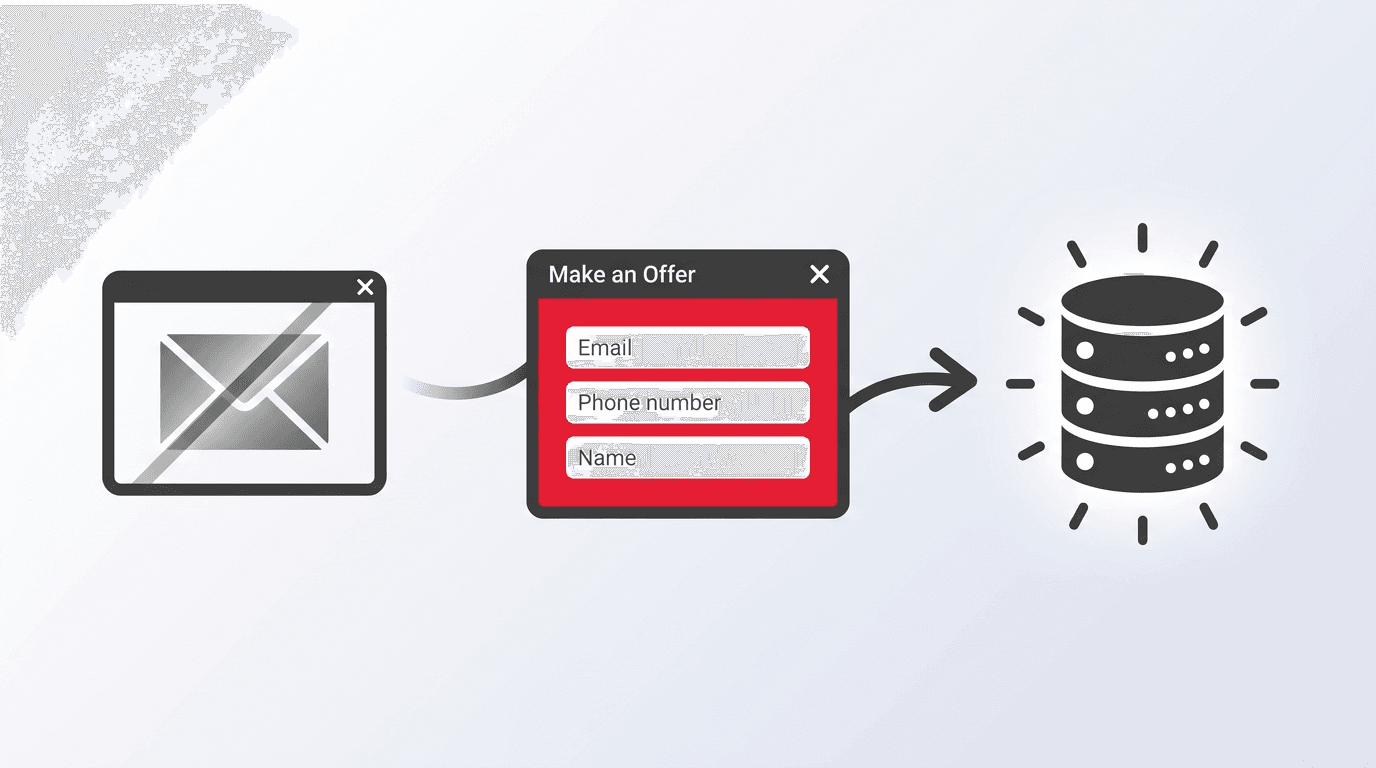
That's exactly what happens when you use a "make an offer" mechanism for lead capture. When a shopper submits an offer on a product, they provide their email, phone number, and name — whether the offer is accepted, countered, or declined. Every single offer is a lead, and every single lead comes pre-loaded with purchase intent data.
Why This Beats a Newsletter Popup
Compare the data you get from each approach:
- Newsletter popup: Email address. Maybe a first name. No product interest. No price sensitivity data. No purchase intent signal.
- Offer submission: Email, phone number, name, specific product of interest, exact price they'd pay, and a clear signal that they want to buy — they just need the right price.
That second lead is exponentially more valuable. You know what to sell them, how much to sell it for, and how to reach them on multiple channels. When you load that lead into Klaviyo or your email platform, you're not sending generic newsletters — you're sending targeted messages about products they've already told you they want.
The Numbers Make It Clear
Email marketing in e-commerce delivers $36–42 for every dollar spent. But that ROI depends entirely on the quality of your list. A list of newsletter subscribers who signed up for a coupon will respond differently than a list of shoppers who actively tried to buy a specific product at a specific price.
The best welcome series — typically 3 emails over 5 days — works by building on whatever intent the shopper showed. When that intent is "I entered my email to get 10% off," you have a weak foundation. When that intent is "I offered $65 for this leather jacket," you have a conversation to continue.
How Lury Makes This Work
With Lury, the offer form captures email, phone, and name on every submission. Smart rules handle the negotiation automatically — accepting offers at or above your floor price, countering with a middle-ground number, or declining lowball offers. But even declined offers capture the lead.
That means your lead capture isn't limited to shoppers who convert. It includes every shopper who expressed enough interest to engage with your pricing. You're building a database of price-sensitive buyers — and that database is gold.
Strategy 2: Exit-Intent as a Lead Gen Tool
Most merchants think of exit-intent popups as a conversion recovery tool. The shopper is leaving, so you throw a discount at them: "Wait! Here's 10% off!" Sometimes it works. Often it doesn't. And when it does work, you've just given away margin to someone who might have come back anyway.
But what if you reframed exit-intent as a lead generation tool instead of a last-ditch conversion tactic?
The Difference Between Claiming a Coupon and Making an Offer
When your exit-intent popup says "Get 10% off," the shopper is passive. They claim a coupon, maybe use it, probably forget about it. The interaction is transactional in the shallowest sense — they gave you an email, you gave them a code. There's no engagement, no dialogue, no data beyond an address in your list.
When your exit-intent popup says "Before you go — make us an offer," something fundamentally different happens. The shopper becomes an active participant in a negotiation. They're thinking about the product, considering what it's worth to them, and committing to a number. Even if you decline their offer, you've accomplished three things:
- You've captured their email, phone, and name. They filled out the offer form. That's your lead.
- You know what they'd pay. That's pricing intelligence you can use in remarketing and future promotions.
- You've created a memorable interaction. "I made an offer and they countered" is more engaging than "I got a 10% off popup." They're more likely to remember your store and come back.
Exit-Intent Lead Quality vs. Standard Popups
Consider the timing. An exit-intent popup fires when the shopper is about to leave. They've already browsed your products. They may have added something to their cart. They've shown more intent than a first-time visitor who just landed on your homepage.
A multi-step popup approach — collecting email first, then phone, then name — can increase completions, but each additional field typically costs about 2% conversion. With an offer-based exit popup, the fields feel justified because they're part of a transaction, not just a data grab. Shoppers expect to provide contact info when they're making a purchase offer.
For a detailed walkthrough of setting up exit-intent offers, including trigger timing and mobile considerations, check out our guide to exit-intent offers.
Strategy 3: Building a "Price-Sensitive" Segment
This is where most merchants leave enormous value on the table — and it's the strategy almost nobody talks about.
Every declined offer is a data point. The shopper told you exactly what product they want and exactly what they'd pay. When you decline their offer because it was below your floor price, that interaction doesn't have to be the end of the relationship. It should be the beginning of a targeted remarketing strategy.
How to Build the Segment
Here's the tactical playbook:
- Export your declined offers. Pull the data from Lury — you'll have the shopper's email, the product they offered on, and the price they submitted.
- Create a "price-sensitive" segment in your email platform. In Klaviyo, Mailchimp, or whatever you use, build a segment of these declined-offer contacts. Tag them with the product category and their offer price.
- When you run a sale that hits their price point, email them directly. If someone offered $55 for a product priced at $80 and you're running a 30% off sale that brings it to $56 — that's their number. Send them a targeted email: "Remember that [product]? It's now in your price range."
This is surgical targeting, not batch-and-blast. You're not sending a generic "SALE! 30% OFF EVERYTHING!" email to your entire list. You're sending a relevant message to someone who already told you what they'd pay, about a product they already said they wanted, at a price that matches what they offered.
Why This Outperforms Standard Sale Announcements
Think about how most Shopify merchants run sales. They discount a category or the entire store, blast their email list, and hope for conversions. The email goes to everyone — buyers, browsers, and people who haven't visited in months. Open rates are decent. Click rates are okay. Conversion rates are mediocre.
Now compare that to an email sent to 200 people who all tried to buy a specific product at a specific price, telling them the product is now available at or below what they offered. That's a fundamentally different email with fundamentally different conversion potential.
And here's the multiplier: 45% of cart recoveries happen within the first 2 hours. The timing data suggests that fast, targeted follow-up dramatically outperforms slow, generic outreach. When you email a price-sensitive segment the moment a relevant sale goes live, you're hitting the recovery window at peak effectiveness.
The Flywheel Effect
Over time, this segment grows. Every declined offer adds another contact with product interest and price sensitivity data. After a few months, you have a rich database of shoppers organized by what they want and what they'll pay. That data informs not just your email strategy but your entire promotional calendar:
- Planning a clearance event? Check which products have the most declined offers and at what price points. That tells you exactly how deep to discount to move inventory. Our guide on clearance done right covers this in detail.
- Launching a new product in a similar category? Email the segment — they've already shown interest in related items and you know their price sensitivity.
- Negotiating with suppliers? If you know that hundreds of shoppers would buy a product at $X, you have real demand data to support your case for better wholesale pricing.
Why These Three Strategies Work Together
These aren't isolated tactics. They form a system:
- Offer-based capture generates leads with rich intent data on every product page where you enable offers.
- Exit-intent offers catch the shoppers who would have left without engaging, adding another layer of lead generation at the critical moment of abandonment.
- Price-sensitive segmentation turns declined offers into a remarketing asset that compounds over time, converting future sales from shoppers who weren't ready today.
Together, they create a lead capture engine that's fundamentally different from a newsletter popup. Instead of collecting email addresses from anonymous visitors, you're building a database of shoppers with declared purchase intent, specific product interests, and known price points. That's the difference between a mailing list and a sales pipeline.
The Data Behind Better Lead Capture
Let's quantify why this matters. With email marketing returning $36–42 per dollar spent in e-commerce, the ROI of your email list depends on two factors: size and quality.
A standard newsletter popup approach optimizes for size. You capture as many emails as possible with a low-friction form and a discount incentive. But list quality suffers — many of those subscribers are coupon hunters who'll never buy at full price, or casual browsers who'll unsubscribe after using the code.
An offer-based approach optimizes for both. You still capture a high volume of leads (every offer submission is a lead, whether accepted or declined), but each lead comes with context that makes your marketing dramatically more effective. When your abandoned cart flow sends emails at 1 hour, 24 hours, and 72 hours, those emails can reference the specific product and price point — not just a generic "you left something in your cart."
Back-in-stock notifications are another example of high-intent lead capture — customers who sign up already want the product. Offer-based leads are even higher intent because they've not only expressed interest but told you their price. Layer these approaches together with loyalty program signups and you have a multi-channel lead capture strategy that leaves the basic newsletter popup far behind.
Getting Started: Replace One Popup, Keep the Rest
You don't have to abandon your newsletter popup entirely. In fact, the smartest approach is layered. Keep your welcome popup for first-time visitors who haven't shown product interest yet. But for shoppers who are browsing products and showing exit intent? Replace the generic discount popup with a "make an offer" prompt.
Here's a simple rollout plan:
- Week 1: Install Lury and enable offers on your top 5 products by revenue. Set floor prices at your minimum acceptable margin.
- Week 2: Enable exit-intent offers for those same products. Monitor the lead capture rate vs. your existing popup.
- Week 3: Export your first batch of declined offers and create a price-sensitive segment in your email platform.
- Week 4: Run a targeted promotion to the price-sensitive segment. Measure conversion rate against your standard sale email.
Within a month, you'll have hard data comparing offer-based lead capture against your newsletter popup — not theoretical arguments, but real numbers from your own store.
Stop Capturing Emails. Start Capturing Intent.
The newsletter popup had its moment. It's still a valid tool for building a general mailing list. But if lead capture is a core part of your growth strategy — and for 97% of visitors who don't buy, it should be — you need approaches that capture more than an email address.
Offer-based lead capture gives you product interest, price sensitivity data, and multi-channel contact info on every submission. Exit-intent offers catch leaving shoppers with an engagement mechanism that feels like a conversation, not an interruption. And price-sensitive segmentation turns every declined offer into a future sales opportunity.
Lury offers three plans with a 14-day free trial, starting at $4.99/mo. Set it up in minutes, enable offers on a few products, and see how much richer your lead data becomes when shoppers tell you what they want to pay — instead of just giving you an email for a coupon.
Related Articles
Clearance Done Right: How to Move Dead Stock Without Devaluing Your Brand
Move slow inventory without fire sales. Learn how make-an-offer pricing clears dead stock while protecting your brand perception.
How to Turn Abandoned Visitors Into Email Subscribers (Even Without a Sale)
Most stores only capture emails at checkout. Here's how to build a list from every visitor who engages — even the ones who don't buy.
5 Shopify Collections That Should Always Have 'Make an Offer' Enabled
Which product types benefit most from make-an-offer pricing? These 5 collections drive more revenue when shoppers can negotiate.