Clearance Done Right: How to Move Dead Stock Without Devaluing Your Brand
Move slow inventory without fire sales. Learn how make-an-offer pricing clears dead stock while protecting your brand perception.
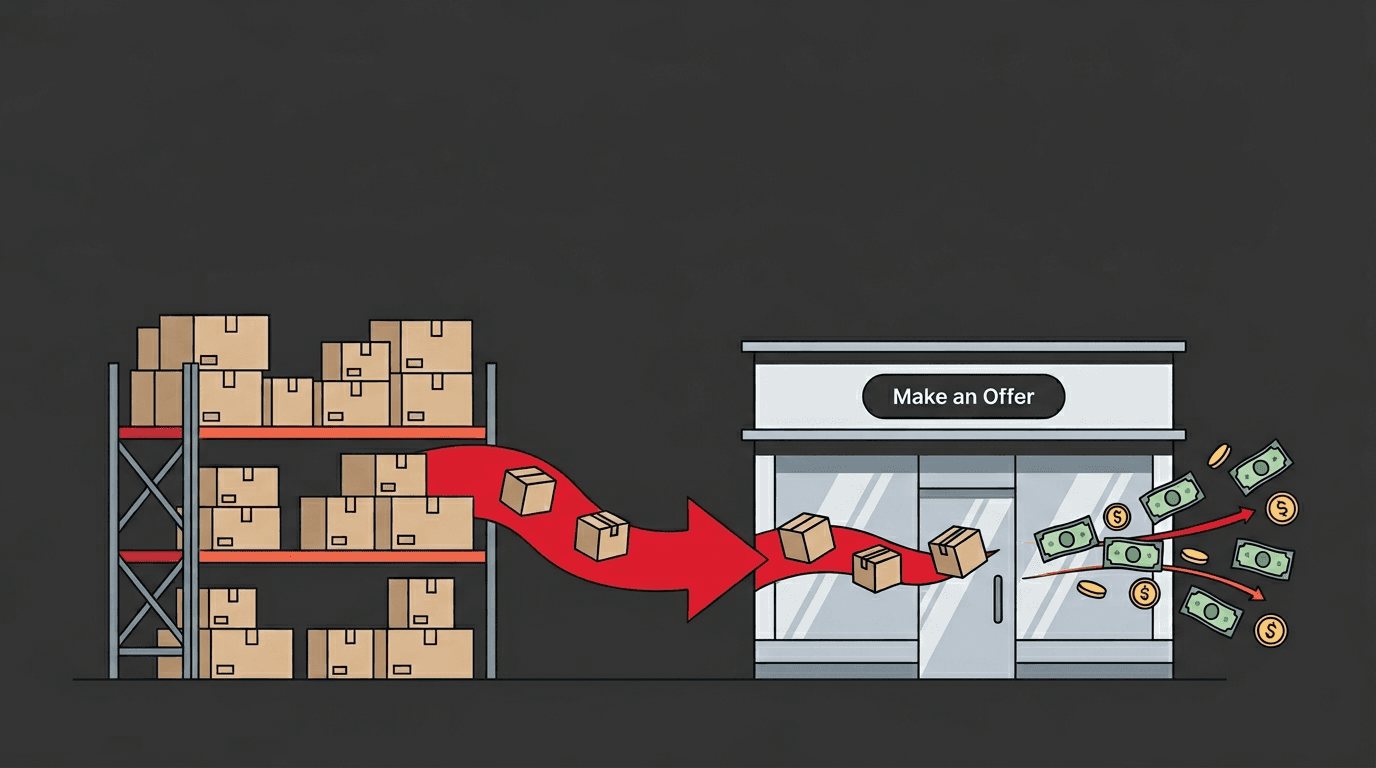
Dead Stock Is Expensive — But Clearance Sales Are Costly Too
Every Shopify merchant knows the sinking feeling: a collection that looked promising three months ago is now gathering dust. The instinct is to slash prices, slap a "CLEARANCE" banner on the site, and move on. But that instinct has a hidden cost.
Sitewide clearance sales send a signal to your customers: this product was never worth what we charged for it. Worse, they train your audience to wait for the next markdown. According to McKinsey's State of Fashion report, over 30% of full-price merchandise in fashion retail ends up marked down — and brands that rely on markdowns see declining full-price sell-through rates year over year.
There's a better way to move slow inventory without broadcasting desperation. It starts with understanding the real cost of dead stock and the real damage of clearance sales — then using a smarter tool to bridge the gap.
The Real Cost of Sitting on Unsold Inventory
Dead stock isn't just an annoyance. It's an active drain on your business in ways that don't always show up on a P&L statement.
- Warehousing and storage fees. Whether you're using a 3PL or your own space, every SKU that sits on a shelf costs money. The average warehousing cost in the U.S. runs $8–$12 per square foot per month, and that adds up fast for bulky or seasonal items.
- Tied-up capital. Money locked in unsold inventory is money you can't spend on new products, marketing, or growth. For smaller stores, this opportunity cost can be existential.
- Shelf-space competition. Every slow-moving SKU occupies space — physical or digital — that a faster seller could fill. Your bestsellers deserve the spotlight.
- Obsolescence risk. Seasonal products, tech accessories, trend-driven fashion — the longer inventory sits, the less it's worth. Some products go from "slow mover" to "worthless" faster than you'd expect.
The bottom line: holding dead stock is a losing strategy. But the way you move it matters enormously for your brand's long-term health.
The Race to the Bottom: Why Traditional Markdowns Backfire
Here's how most clearance events play out. You start with 20% off. Traffic bumps slightly, but sell-through is modest. After a week, you move to 30% off. A few more units move. Then 40%. Then 50%. By the end, you're practically giving product away — and the customers who paid full price two months ago feel cheated.
Each progressive markdown sends a louder signal: we couldn't sell this at any reasonable price. That perception doesn't stay contained to clearance items. It bleeds into how customers view your brand overall.
Research from Harvard Business Review found that frequent promotions erode brand equity over time, making customers less willing to pay full price for any product — including new arrivals. You're not just discounting one collection; you're discounting your entire brand perception.
There are three specific problems with the public-markdown approach:
- It trains customers to wait. Why buy today at full price when there's always a clearance event around the corner?
- It attracts low-LTV shoppers. Bargain hunters who come for 50%-off clearance rarely return at full price. They're loyal to the deal, not the brand.
- It creates a price anchor. Once a customer sees your $120 jacket at $60, that's the new reference price in their mind. Good luck selling the next season's version at $120.
A Better Approach: Let the Customer Name the Price
What if, instead of publicly slashing prices, you let customers privately tell you what they'd pay? That's the core idea behind name-your-price negotiation — and it changes the entire clearance dynamic.
When a customer makes an offer on a slow-moving product, the psychology shifts. They're not seeing a desperation markdown. They're initiating a negotiation. The product still has its listed price. The brand still holds its position. But the door is open for a customer who's genuinely interested to propose a number that works for both sides.
With Lury, you can enable a "Make an Offer" button on specific products or entire collections. Set a floor price — the minimum you'll accept — and Lury's smart rules handle the rest automatically. Offers above the floor are accepted instantly. Offers below get declined or countered. No manual negotiation, no public markdowns, no brand damage.
Why This Works Better Than Clearance Sales
- The listed price stays intact. There's no public signal that you're desperate to sell. The product page looks the same as any other product in your store.
- Each deal is private. The customer who pays $55 for a $100 item doesn't broadcast that price to everyone else. Lury generates single-use discount codes — no sharing, no coupon sites scraping your deals.
- Customers feel like they won. A successful negotiation activates the same reward circuitry as winning an auction. The customer walks away satisfied, not feeling like they bought something nobody else wanted.
- You set the boundaries. Your floor price is your floor. No one gets product below your true cost. Unlike progressive markdowns, you're never pressured into going lower than planned.
Setting Up a Smart Clearance Strategy With Floor Prices
The key to making this work is tiered floor pricing. Not every product in your catalog should have the same threshold. Here's a framework that works well for most Shopify stores (and you can read the full breakdown in 5 Pricing Strategies That Turn Price-Sensitive Shoppers Into Buyers):
Best Sellers: Tight Floors (90–95%)
These products don't need aggressive discounting. They're selling fine. But enabling "Make an Offer" at 90–95% of listed price captures the occasional price-sensitive buyer who's comparing shops. A $95 sale on a $100 product is still better than losing the customer entirely.
Mid-Range Products: Moderate Floors (75–85%)
Products that sell steadily but not quickly benefit from a wider negotiation window. A customer who offers $80 on a $100 item is showing real purchase intent. Enable Lury's counter-offer feature here — if someone offers $65, counter at $80. You'll often land at $75–$80, which is solid revenue from a customer who might otherwise have bounced.
Slow Movers and Dead Stock: Aggressive Floors (50–60%)
This is where the magic happens for clearance. Set your floor at 50–60% of the listed price. A $50 sale on a $100 item is dramatically better than the alternative: marking it down publicly to $50 (training customers to wait), holding it until it's worthless, or writing it off entirely.
The critical difference? The customer initiated the discount. They made an offer, and you accepted. There's no "SALE" banner cheapening your homepage. There's no Honey extension alerting everyone that your products are marked down. It's a private transaction at a price both sides agreed to.
Seasonal Timing: Get Ahead of the Clearance Curve
Timing matters. Most stores wait until inventory is truly dead before discounting — by then, they've already absorbed months of carrying costs and the products are harder to sell. A smarter approach: enable "Make an Offer" on end-of-season items 2–3 weeks before you'd typically run a clearance sale.
Here's why this timing works:
- Early demand discovery. You'll quickly learn what customers are actually willing to pay. If offers cluster around 70% of listed price, that's the market telling you the real value — and you can use that intel to set public markdowns later (if needed) at the right level, not the guessing game of 20%→30%→40%.
- Higher sell-through at better prices. The first customers to engage with "Make an Offer" are often willing to pay more than the bottom-feeders who show up at the end of a 50%-off sale. You capture better margins early.
- Reduced leftover inventory. By the time you'd normally start a clearance event, you've already moved a chunk of inventory through private negotiations. Whatever's left can go to clearance with less impact on your brand.
Think of it as letting the market price your inventory before you mark it down publicly. You get real demand signals instead of guessing.
The Lead Capture Bonus: Profit Even From Declined Offers
Here's something most merchants don't consider: even when you decline a lowball offer, you still win.
Every offer submitted through Lury captures the customer's email address — and optionally their name and phone number. That means a customer who offers $30 on a $100 item (well below your $50 floor) still gives you their contact information. You've just identified a price-sensitive shopper who's interested in your product.
What can you do with that lead?
- Retarget with email. Add them to a segment in Klaviyo or Mailchimp. When you do eventually run a seasonal sale, these customers are pre-qualified — they already told you they want the product.
- Trigger a follow-up flow. Send an automated email: "Your offer wasn't accepted, but here's 15% off for the next 48 hours." This creates urgency without a public markdown.
- Build long-term value. Some of today's bargain hunters become tomorrow's full-price customers. Getting them into your email list is the first step.
Traditional clearance sales don't capture any of this data. A customer who browses your 40%-off section and leaves? Gone forever. With a make-an-offer approach, even the ones who walk away leave their contact info behind.
Pair It With Exit-Intent for Maximum Recovery
For dead-stock products, consider combining aggressive floor prices with Lury's exit-intent popup. When a customer's cursor heads for the back button — on any product page, but especially on slow movers — trigger the offer form.
This is your last chance to engage a leaving visitor. On a clearance product with a 50% floor, you have plenty of room to accept a reasonable offer. The customer gets a deal they feel good about. You move a unit of dead stock. And you capture their email regardless of the outcome.
It's the clearance equivalent of a store associate saying, "Before you go — what would you pay for that?" Except it's automated, runs 24/7, and doesn't require hiring anyone.
Moving Forward: Clear Inventory Without Clearing Your Brand
Dead stock is an inevitable part of retail. No merchant bats a thousand on product selection. The question isn't whether you'll have slow movers — it's how you handle them.
Traditional clearance sales are a blunt instrument. They move product, but they also move your brand perception in the wrong direction. A make-an-offer strategy gives you the same outcome — inventory cleared, capital freed — without the collateral damage of public markdowns.
The formula is straightforward: enable "Make an Offer" on slow-moving collections with aggressive floors, let customers initiate the negotiation, capture their contact info regardless of outcome, and keep your brand's full-price positioning intact.
Start your free trial and start moving dead stock today. Every plan includes a 14-day free trial, with plans from $4.99/mo — pick the tier that fits your clearance volume.
Related Articles
Lead Capture Beyond the Newsletter Popup: 3 Strategies Shopify Merchants Are Missing
Most Shopify stores rely on newsletter popups for leads. Discover 3 strategies that capture higher-intent leads with richer data.
How Exit-Intent Offers Recover Abandoned Revenue
Learn how to configure Lury's exit-intent popup to catch leaving visitors and turn last-second bounces into real orders.
5 Pricing Strategies That Turn Price-Sensitive Shoppers Into Buyers
Stop losing customers to sticker shock. These five Lury strategies help you capture revenue from shoppers who want your product but hesitate at full price.