Why Single-Use Discount Codes Beat Sitewide Sales Every Time
Public discount codes leak to coupon sites in 48 hours. Single-use codes tied to individual transactions stop the bleeding.
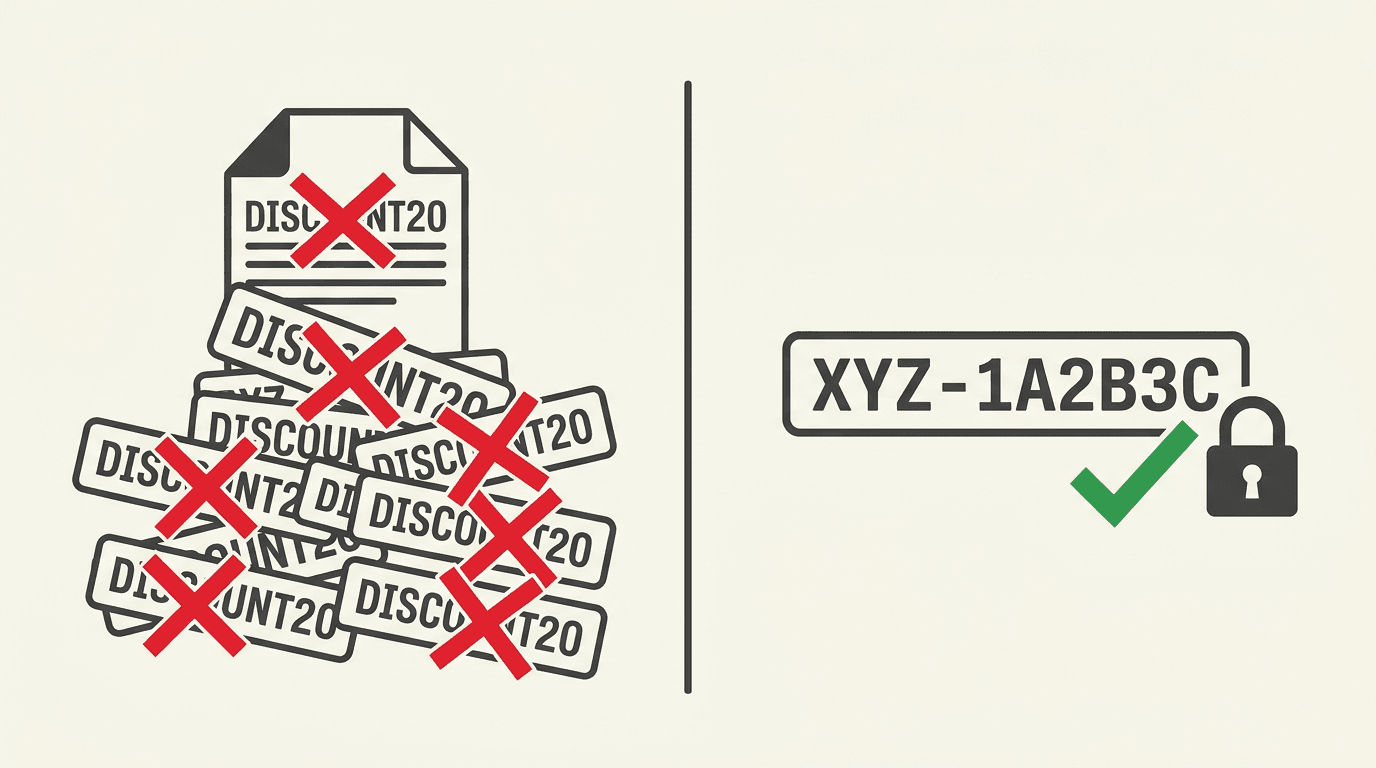
Your Discount Code Is Already on a Coupon Site
You craft a 15% welcome discount for new customers. You set it to "one use per customer." You drop it into your email popup and go to bed feeling smart about your conversion strategy.
Within 48 hours, that code is live on RetailMeNot. By day three, Honey's browser extension is auto-applying it at checkout for anyone — new customer or not. By the end of the week, 73% of public discount codes appear on aggregator sites.
Your "exclusive" welcome offer is now a public coupon. And it's costing you far more than you planned.
The Coupon Economy Is Enormous (and Working Against You)
To understand why discount code leakage is so damaging, you need to understand the scale of the coupon ecosystem that's actively harvesting your codes.
Honey has over 17 million users. Its browser extension sits silently at checkout, automatically testing every known discount code against your store. When one works, Honey saves it to its database — and shares it with every other Honey user who visits your store.
RetailMeNot pulls in over 800 million annual visits. Their business model is simple: aggregate every discount code on the internet and monetize the traffic. Your carefully segmented welcome offer becomes just another row in their database.
Then there are dozens of smaller aggregators — Coupons.com, Groupon, Dealspotr, and browser extensions like Capital One Shopping (formerly Wikibuy) — all competing to surface your codes to shoppers who were already going to buy at full price.
The Real Cost: Cannibalized Full-Price Revenue
The worst part isn't that bargain hunters find your codes. It's that your existing customers — people who were about to pay full price — discover them too. A shopper at checkout thinks "let me Google for a code first," finds your 15% welcome discount on RetailMeNot, and applies it. You just gave away margin to someone who didn't need the incentive.
This is margin erosion that never shows up in your analytics as a problem. It looks like a successful discount code with high redemption. In reality, a significant chunk of those redemptions were full-price sales you just discounted for no reason.
Why "One Per Customer" Limits Don't Actually Work
Shopify offers four discount types: percentage off, fixed amount, buy-one-get-one, and free shipping. All of them let you set usage limits. But "limit to one use per customer" has a fundamental flaw: it relies on the customer being identifiable.
Here's how shoppers bypass it:
- Email aliases: Gmail lets you add "+anything" before the @ sign. john@gmail.com and john+shop@gmail.com are different "customers" to Shopify, but the same inbox.
- Incognito browsing: A new browser session looks like a new customer.
- Multiple email addresses: Most people have at least two or three.
- Guest checkout: No account means no reliable identity tracking across orders.
Consider this case study: a fashion brand launched a 20% welcome discount with a "one per customer" limit. Within 24 hours, the code appeared on three aggregator sites, browser extensions started auto-applying it, and customers created aliases to reuse it. When they audited the numbers, 40% of redemptions came from repeat customers — the exact audience the "limit" was supposed to block.
An Entire Industry Exists to Solve This Problem
The discount leakage problem is so widespread that dedicated SaaS tools have sprung up specifically to combat it — and they aren't cheap.
Vigilance.io is an entire business built around blocking coupon code leaks for Shopify Plus stores. Their pitch is telling: if code leakage weren't a massive problem, there wouldn't be a market for a company whose sole purpose is stopping it.
Omnipotent Discounts charges $50 per month just to monitor and block discount code abuse on your Shopify store. That's $600 a year to play whack-a-mole with coupon sites — and you're still using the same fundamentally leaky discount code model.
An analysis of 117 million Shopify discounts found that 90% are "at risk" of abuse. Nine out of ten. If you're running any kind of static discount code, the odds are overwhelmingly against you.
The Root Problem: Static Codes Are Inherently Shareable
All of these tools — usage limits, leak-blocking apps, coupon monitoring services — are treating the symptom. The root problem is architectural: a static discount code is just a string of text. Text can be copied, shared, posted, scraped, and auto-applied. No amount of monitoring changes this fundamental reality.
It's like putting a lock on a gate while leaving the fence open. You can make the lock fancier. You can add cameras. You can hire a guard. Or you can just build the fence properly in the first place.
The fence, in this case, is a discount code that can't be shared — because it's unique to a single transaction and expires after one use.
Single-Use Codes: Nothing to Leak, Nothing to Share
A single-use discount code is generated for one specific transaction, tied to one specific customer, and valid for one use only. Once redeemed, it's dead. Once expired, it's dead. There's nothing for Honey to scrape, nothing for RetailMeNot to list, nothing for a friend to forward.
This isn't a new concept — major retailers have used unique codes for years. But generating them manually or through complex automations has been impractical for most Shopify merchants. You'd need to create thousands of individual codes, manage their distribution, track their expiration, and ensure they map to the right customers.
What Makes Single-Use Codes Better
- Zero leakage risk: There's no code to post on a coupon site. Even if a customer shares their code, it won't work for anyone else — and it won't work a second time.
- No browser extension exposure: Honey can't auto-apply a code that was generated specifically for a different customer's session. The code doesn't exist in any database for the extension to test.
- Accurate attribution: Every redemption maps to a specific offer and customer. No guessing whether a code was used by its intended recipient or a stranger from RetailMeNot.
- Full margin control: The discount amount is whatever you agreed to in that specific negotiation. No universal percentage that gets over-applied to high-margin products that didn't need discounting.
How Lury Makes Single-Use Codes Automatic
Here's where the name-your-price model solves discount leakage by design, not by adding another layer of defense.
When a shopper makes an offer through Lury and it's accepted (or a counter-offer is agreed upon), the system automatically generates a unique, single-use Shopify discount code for that exact transaction. The code is applied to the shopper's cart immediately. No code is displayed for the customer to copy. No code is emailed in plain text. Nothing enters the coupon ecosystem.
The Flow
- Shopper offers $80 on a $100 product.
- Your auto-accept rule triggers (floor is set at $75).
- Lury generates a unique discount code — something like LURY-a7x9k2 — valid for that product, that amount, one use only.
- The code is applied directly to the cart. The shopper sees the discounted price and checks out.
- After checkout (or expiration), the code is dead. Forever.
There's nothing to monitor, nothing to block, and nothing to chase down on coupon sites. The hidden cost of blanket discounts simply doesn't apply.
Sitewide Sales vs. Negotiated Single-Use Codes: A Comparison
Let's compare the two approaches for a store doing 1,000 orders per month with a $100 average order value.
Sitewide 15% Off Sale
- Every order gets 15% off — including customers who would have paid full price.
- Revenue loss: $15,000 (15% × $100 × 1,000 orders).
- Code leaks to aggregators. Repeat customers reuse it via aliases. Browser extensions auto-apply it.
- Actual discount cost is higher than projected because the code gets used more broadly than intended.
Negotiated Single-Use Codes
- Only shoppers who request a discount receive one. Full-price buyers pay full price.
- Discount depth varies per negotiation — maybe 5% for a best seller, 20% for slow inventory.
- Each code is unique and single-use. No leakage vector exists.
- You capture email and phone on every offer — building a lead capture pipeline that goes beyond the newsletter popup.
The math isn't close. Negotiated single-use codes preserve full-price revenue from customers who don't need discounting while still converting price-sensitive shoppers who would have bounced.
But What About Legitimate Sale Events?
Single-use codes don't mean you can never run a sale. Seasonal promotions, Black Friday, clearance events — these all have their place. The question is whether your everyday discounting strategy should rely on static, shareable codes.
For planned sale events, consider combining approaches. Use your sitewide sale for the big splash, but use name-your-price with single-use codes as your year-round strategy for handling price-sensitive shoppers. The sale creates urgency. The negotiated codes handle the daily drip of visitors who want a deal but don't want to wait for Black Friday.
You can learn more about managing clearance and inventory sales the right way without cannibalizing your margins.
The Data Case: $600/Year in Leak Prevention vs. Built-In Protection
Let's zoom out on the economics. If you're currently using static discount codes, you have two options:
- Pay for leak prevention: Apps like Omnipotent Discounts ($50/mo) or enterprise solutions like Vigilance.io try to detect and block leaked codes. You're spending money to patch a fundamentally broken model. And you're still losing some revenue to leaks that slip through.
- Eliminate the leak vector entirely: With single-use codes generated per transaction, there's nothing to leak. No monitoring app needed. No whack-a-mole with coupon sites. The architecture itself is the protection.
Lury offers three plans with a 14-day free trial, starting at $4.99/mo. No setup cost. No code monitoring dashboards. The single-use code model means leakage prevention is built into the product, not bolted on as an afterthought.
Stop Leaking Margin. Start Negotiating.
Static discount codes were designed for a simpler era — before browser extensions had 17 million users scraping codes, before aggregator sites had 800 million annual visits, and before 73% of public codes ended up on coupon sites within a week.
The merchants who are winning today aren't the ones with the best coupon-blocking tools. They're the ones who've moved past the leaky-code model entirely. Single-use codes, generated per transaction and tied to individual negotiations, eliminate the problem at the root.
Start your free trial on your Shopify store and let every accepted offer generate its own unique, single-use discount code. No leakage. No monitoring. No sharing. Just clean, margin-preserving discounts for the shoppers who actually need them.
Related Articles

The 24-Hour Discount Window: Why Offer Urgency Beats 'Forever' Codes
Every accepted offer in Lury generates a single-use code with a short expiration window. Here's why that beats an evergreen public discount code.

One Counter, Not Ten: Why a Single Counter-Offer Beats Endless Haggling
Lury sends at most one counter-offer per negotiation. Here's the behavioral research on why that constraint converts better than open-ended haggling.

Percent Off vs. Percent Of: The Pricing Math Mistake Costing Collections Merchants Money
One inverted number in your collection offer settings can mean the difference between a 10% discount and a 90% discount. Here's how to get it right.