The Hidden Cost of Blanket Discounts: Why 20%-Off-Everything Is Killing Your Margins
Sitewide discount codes leak to coupon sites, train shoppers to wait, and erode margins. Learn why personalized pricing wins.
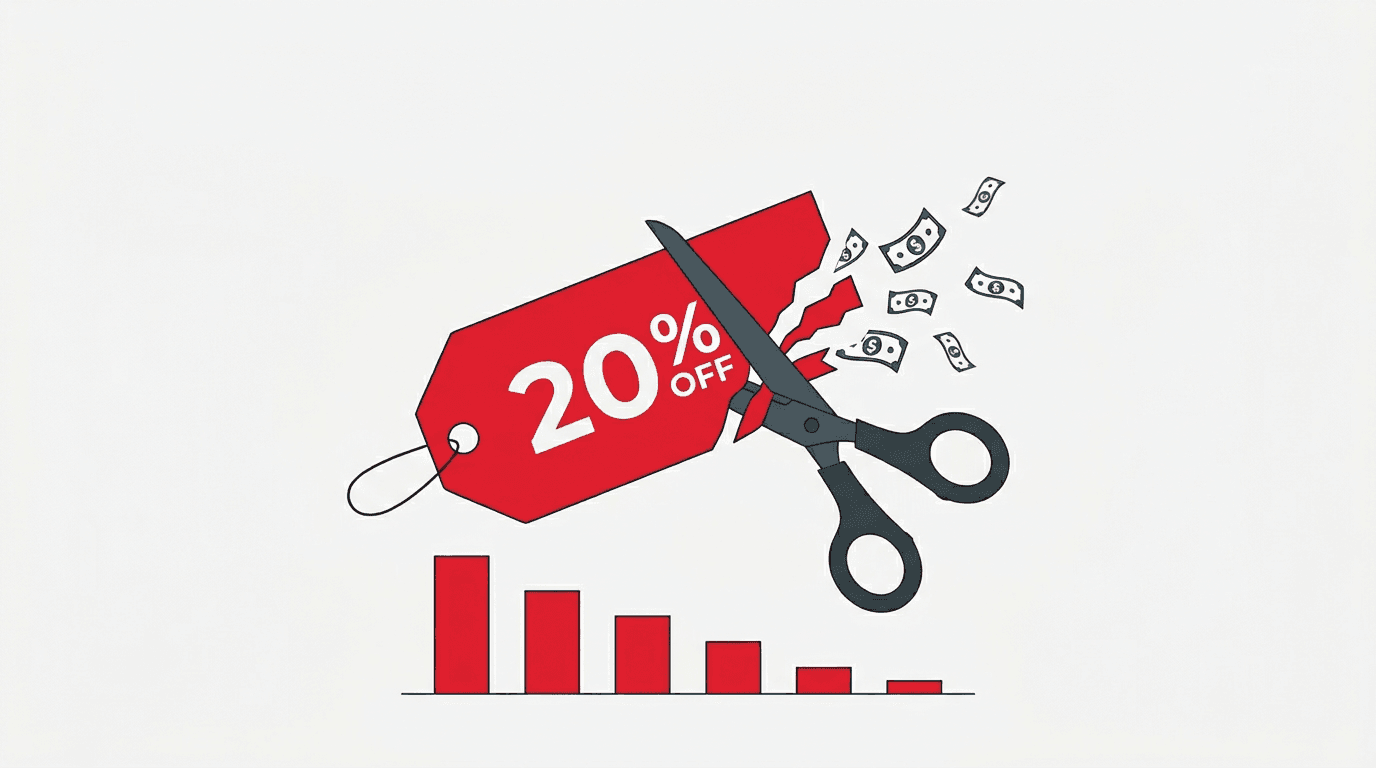
The Discount Trap Every Shopify Merchant Falls Into
You've seen the playbook a hundred times: launch a "20% off everything" sale, blast it to your email list, watch orders spike for 48 hours, then spend the next two weeks wondering why your margins look terrible. Worse, you notice customers now wait for your next sale instead of buying at full price.
This isn't a feeling — it's a documented pattern. 70% of Shopify stores use discounts as their primary lead capture mechanism. Pop up a "Get 15% off your first order" in exchange for an email, run a sitewide sale every month, and hope the volume makes up for the margin hit. For most stores, it doesn't.
The real cost of blanket discounts isn't the margin you lose on the orders you get — it's the full-price revenue you'll never see again because you've trained your customers that waiting pays off.
How Discount Codes Leak (Faster Than You Think)
Here's a stat that should make every merchant uncomfortable: 73% of public discount codes appear on coupon aggregator sites within one week of first use. Many surface within 48 hours.
That "exclusive" 20% off code you sent to your email list? It's on RetailMeNot before your campaign even finishes. Here's how the leakage pipeline works:
- Coupon aggregator sites — RetailMeNot alone sees over 800 million annual visits. Slickdeals, Coupons.com, and dozens of smaller players constantly scrape and crowdsource codes.
- Browser extensions — Honey (now owned by PayPal) has 17+ million users who auto-test discount codes at checkout. Every time one of your codes works for a Honey user, it gets logged and shared with the entire network.
- Social sharing — Shoppers share codes in Facebook groups, Reddit threads, and WhatsApp chains. One post in a deals forum can expose your code to thousands of non-subscribers.
The average lifespan of a discount code on aggregator sites is roughly 48 hours from first public use. But the damage is permanent — those sites archive old codes, and shoppers learn to check them before every purchase from your store.
The Scale of the Problem
An analysis of 117 million Shopify discount codes found that 90% are "at risk" — meaning they lack the usage limits, expiration dates, or customer restrictions needed to prevent abuse. That's nine out of ten codes floating around without meaningful guardrails.
And it gets more creative than simple sharing. One fashion brand discovered that 40% of "one per customer" code redemptions were repeat customers using email aliases. The limit was technically enforced — one code per email — but the same people were signing up with variations like john+deals@gmail.com and john.deals@gmail.com to collect multiple discounts.
If your discount strategy relies on trust and honor systems, the data says you're losing that bet.
The Three Hidden Costs of Sitewide Sales
1. Margin Erosion Across the Board
A 20% sitewide discount means every customer gets 20% off — including the ones who would have bought at full price. If 60% of your sale-period revenue would have happened anyway, you've effectively donated 20% of that revenue for no incremental gain.
Run the math on a $100,000 month with a 20% sitewide discount. If $60,000 of that would have been full-price purchases, you just left $12,000 on the table. Not revenue — pure margin. And that's before accounting for leaked codes extending the discount beyond your intended sale window.
2. Customer Conditioning
This is the cost that compounds over time and rarely shows up in any dashboard. When you run regular sales, you train your audience to wait. Why buy today at full price when you'll probably run another 20%-off event next month?
It shows up in subtle ways:
- Declining full-price conversion rates between sales
- Growing email lists with subscribers who only engage during promotions
- Increasing reliance on discounts to hit monthly targets
- Higher "unsubscribe on non-promo email" rates
Once customers are conditioned, it's extraordinarily hard to undo. Some brands never recover — they become permanently dependent on promotions to drive any meaningful volume.
3. Brand Perception Damage
There's a reason luxury brands almost never run percentage-off sales. Constant discounting signals that your listed price isn't the real price — it's the "before" number that exists to make the discount look good. Over time, this erodes the perceived value of your products and positions your brand as a discount player, regardless of your actual product quality.
For Shopify merchants selling at mid-to-premium price points, this is particularly dangerous. You've invested in product quality, branding, photography, and customer experience — then a "25% OFF EVERYTHING 🎉" popup undermines all of it in three seconds.
Usage Limits Aren't the Answer (But They Help)
The standard advice is to add usage limits to your discount codes: cap total uses, restrict to one per customer, set expiration dates. These are basic hygiene — you should absolutely implement them. But they don't solve the underlying problem.
Capping a code to one use per customer doesn't stop it from appearing on RetailMeNot for other customers to use. Setting an expiration date means the code still works for anyone who finds it within the window. And as the email-alias example shows, "one per customer" enforcement is only as good as your ability to identify unique customers.
The fundamental issue is that a discount code is a shared secret. The moment more than one person knows it, you've lost control. And in a world with browser extensions that automatically test codes at checkout, "secret" has a very short shelf life.
The Alternative: Per-Customer Negotiated Pricing
What if instead of broadcasting a single code to thousands of people, every discount was individually negotiated, unique to one customer, and impossible to share?
That's the premise behind "make an offer" pricing. Instead of setting a sitewide discount and hoping the math works out, you let each shopper tell you what they're willing to pay. Smart rules evaluate the offer against your floor price — auto-accepting strong offers, countering reasonable ones, and declining lowball bids — all instantly and automatically.
Here's why this approach solves the problems that blanket discounts create:
No Leakage — Ever
When an offer is accepted, the shopper receives a single-use discount code tied to their specific offer. The code works once, for one customer, on one cart. It can't be shared on a coupon site because it only works for the person it was generated for. Honey can't scrape it because it doesn't exist until an offer is accepted. RetailMeNot can't list it because it has no value to anyone else.
This is margin protection at a structural level — not policy-based restrictions that rely on customer compliance.
No Conditioning
Because there's no public sale, no sitewide code, and no promotional calendar to train customers around, shoppers don't learn to wait. The "make an offer" button is always available, and the negotiation happens in real time. There's no advantage to coming back next week — the mechanism is the same today, tomorrow, and next month.
This is a fundamental shift. Instead of periodic discounting events that create demand volatility, you have a steady-state pricing mechanism that smooths revenue and preserves full-price purchases for shoppers who don't feel the need to negotiate.
Margin Protection by Default
With floor prices set per product or per collection, you define the absolute minimum you'll accept. A shopper can't negotiate below your floor — the system declines automatically. Compare that to a 20% sitewide sale where your best-selling, highest-margin product gets the same discount as your lowest-margin SKU.
Per-product floor pricing means you can be more aggressive on slow movers (where you need help) and more protective on bestsellers (where demand is already there). That level of granularity is impossible with blanket discounts. For more on setting this up effectively, see our guide on collections that should have make an offer.
What You Gain Beyond Revenue
The margin math alone justifies moving away from blanket discounts. But there are downstream benefits that compound over time.
Price Intelligence
Every offer is a data point. When 50 customers offer $79 for a product listed at $99, that tells you something meaningful about price sensitivity for that SKU. Over time, offer data reveals optimal pricing levels you couldn't discover with A/B testing — because shoppers are volunteering their willingness to pay.
This is market research that happens passively, at zero additional cost, while generating revenue.
Lead Capture on Every Interaction
Every offer submission — accepted, countered, or declined — captures the shopper's email, phone number, and name. Even the shoppers you decline are now in your CRM with rich context: which product they wanted, what they were willing to pay, and when they were shopping.
Compare that to your current lead capture. Most stores offer "15% off for your email" — a blanket discount that attracts deal-seekers. Make-an-offer lead capture attracts buyers — people who expressed genuine purchase intent for a specific product. The quality difference in your email list is substantial. Learn more in our deep dive on lead capture beyond the newsletter popup.
Better Customer Experience
This might be counterintuitive, but shoppers prefer negotiation over hunting for coupon codes. The psychology of name-your-price shows that the act of making an offer creates a sense of ownership and engagement that static discount codes never achieve. The customer feels like they got a deal they earned — not one that everyone else got too.
Making the Switch: A Practical Framework
You don't have to abandon discounts overnight. Here's a phased approach:
- Audit your current discount usage. Check how many active codes you have, where they've leaked, and what percentage of revenue comes from discounted vs. full-price orders.
- Start with clearance and slow movers. Enable "make an offer" on products you'd discount anyway — seasonal inventory, overstocked SKUs, last-season styles. Set aggressive floor prices and let the market tell you what they'll pay. See our approach to clearance done right.
- Expand to exit intent. Replace your "here's 10% off" exit popup with a "make an offer before you go" prompt. You'll capture more revenue and better leads without training the discount reflex.
- Phase out sitewide codes. As per-customer negotiation proves out, reduce the frequency and depth of sitewide sales. Monitor full-price conversion rates — they should start recovering as customer conditioning fades.
The Bottom Line
Sitewide discounts are the junk food of e-commerce revenue — they feel good in the moment and leave you worse off long-term. They leak to coupon sites, train customers to wait, erode margins on products that didn't need discounting, and damage brand perception.
Per-customer negotiated pricing — powered by smart rules and single-use codes — gives you everything discounts promise (more conversions, customer engagement, competitive pricing) without the hidden costs. Every deal is unique. Every code is single-use. Every interaction captures a lead. And your floor prices ensure you never give away more margin than you intended.
Lury offers a 14-day free trial on every plan, starting at $4.99/mo — a smarter alternative to the discount codes that are quietly eating your margins. Try it on a single collection and see the difference for yourself.
Related Articles
How Exit-Intent Offers Recover Abandoned Revenue
Learn how to configure Lury's exit-intent popup to catch leaving visitors and turn last-second bounces into real orders.
5 Pricing Strategies That Turn Price-Sensitive Shoppers Into Buyers
Stop losing customers to sticker shock. These five Lury strategies help you capture revenue from shoppers who want your product but hesitate at full price.
Clearance Done Right: How to Move Dead Stock Without Devaluing Your Brand
Move slow inventory without fire sales. Learn how make-an-offer pricing clears dead stock while protecting your brand perception.