The Psychology of 'Name Your Price': Why Letting Shoppers Negotiate Increases Conversion
Behavioral economics explains why name-your-price works. Anchoring, the IKEA effect, and loss aversion turn browsers into buyers.
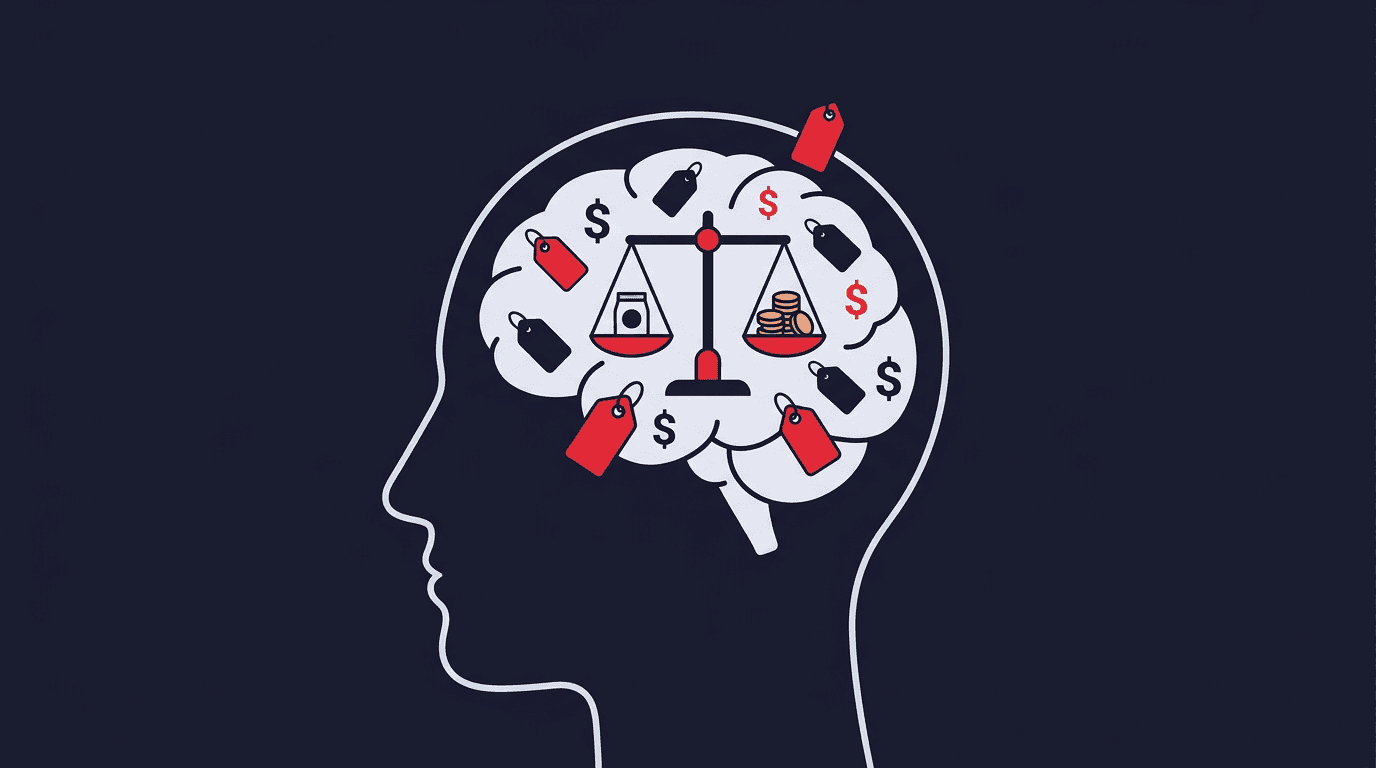
The Conversion Gap Nobody Talks About
Here's a number that should bother every Shopify merchant: roughly 7.5% of visitors add something to their cart, but only about 2% actually buy. That's a massive drop-off between "I want this" and "I'll pay for this."
The average Shopify store converts at just 1.4%, while top performers hit 4.7%. What separates the top from the average isn't always better products or prettier stores — it's often how they handle the moment a shopper hesitates on price.
Price sensitivity is the leading reason for cart abandonment at 39–48%. Not shipping costs. Not complicated checkouts. The price itself. And yet most stores respond to this with one blunt tool: a blanket discount code. That's like performing surgery with a sledgehammer.
There's a smarter approach grounded in decades of behavioral economics research: let the shopper name their price. Here's why it works — and why the psychology behind it is more powerful than any coupon code.
The Anchoring Effect: Your Listed Price Does the Heavy Lifting
In 1974, psychologists Daniel Kahneman and Amos Tversky described what they called the "anchoring effect" — the human tendency to rely disproportionately on the first piece of information encountered when making decisions. In negotiations, the first number on the table sets the entire frame.
When your product page shows $120, that number becomes the anchor. Every offer a shopper considers is measured against it. They don't think "what's the cheapest I can get this for?" — they think "how far below $120 can I reasonably go?"
This is why name-your-price doesn't lead to a flood of $1 offers. Research consistently shows that offers cluster close to the anchor price. A shopper looking at a $120 product typically offers $85–$105 — not $20. The listed price has already done its persuasive work before the negotiation even begins.
How This Plays Out in Practice
Amazon understands dynamic pricing better than anyone, changing prices 2.5 million times per day. They know the "right" price isn't fixed — it shifts based on context, demand, and individual willingness to pay. Name-your-price brings that same flexibility to independent Shopify stores, without needing Amazon's army of data scientists.
The key insight: you're not abandoning your pricing power. Your listed price remains the anchor. You're simply opening a channel for shoppers to tell you what that anchor is worth to them.
The Endowment Effect: Making Offers Creates Ownership
The endowment effect is one of the most reliable findings in behavioral economics: people value something more simply because they feel a sense of ownership over it. In classic experiments, people who were given a coffee mug demanded roughly twice as much to sell it as others were willing to pay to buy it. Ownership — even the feeling of ownership — changes perceived value.
Here's where it gets interesting for e-commerce. When a shopper submits an offer on a product, something subtle happens psychologically. They've invested time, attention, and mental energy into the transaction. They've envisioned owning the product. They've done math in their head. They've typed a number into a form.
That act of making an offer creates psychological investment. The product is no longer just another item in a catalog — it's their potential purchase, at their price. Walking away now means losing something they've already started to "own" mentally.
Why This Beats a Static Discount
Compare this to a standard 15%-off popup. The shopper didn't earn anything. They didn't participate. The discount just appeared. There's no investment, no ownership, no loss if they close the tab. A name-your-price interaction creates stakes that a coupon code never can.
This is also why capturing lead data on every offer — even declined ones — is so valuable. That shopper who offered $70 on a $100 product and got declined? They're psychologically primed. Send them a targeted email when you run a sale at $79, and they're far more likely to convert than a cold subscriber.
The IKEA Effect: We Value What We Help Create
In 2012, researchers Michael Norton, Daniel Mochon, and Dan Ariely published a landmark paper on what they called the "IKEA effect" — the finding that people place disproportionately higher value on products they partially created. The wobbly bookshelf you assembled yourself? You love it more than a perfect one from a furniture store.
The same principle applies to prices. A negotiated price feels fundamentally different from a fixed price, even when the final number is identical. If a shopper gets 15% off through their own offer, it feels like an achievement. If they get the same 15% from a popup, it feels like charity.
This matters for post-purchase satisfaction, too. Buyers who negotiate their price report higher satisfaction with their purchase and are less likely to request returns. They feel the price is "fair" because they participated in setting it. That sense of fairness is impossible to manufacture with a promo code.
The Participation Premium
Think about it from the shopper's perspective. Two identical scenarios:
- Scenario A: You visit a store, see a jacket for $150, apply a 20%-off code from a popup, and pay $120.
- Scenario B: You visit a store, see a jacket for $150, offer $115, get countered at $125, counter back at $120, and the store accepts.
Same jacket, same price. But Scenario B feels better. You negotiated. You got "your" price. That emotional difference translates into higher conversion rates, better reviews, and stronger brand loyalty.
Loss Aversion: The Fear of Missing Your Own Deal
Kahneman and Tversky's prospect theory established that losses loom larger than equivalent gains — roughly twice as large, psychologically speaking. We feel the pain of losing $50 more intensely than the pleasure of gaining $50.
Name-your-price activates loss aversion in a way that benefits both merchant and shopper. Once a shopper submits an offer and it's accepted (or countered), they face a choice: complete the purchase or lose the deal they just created.
This is dramatically different from browsing with a generic discount code in hand. A code feels abstract — you can always come back later, or find another one. But a personalized, accepted offer? That feels concrete and time-limited. Letting it expire feels like a loss.
This is precisely why exit-intent offers are so effective at recovering abandoned revenue. A shopper heading for the door gets one more chance to name their price. The combination of exit urgency and personal offer creates a powerful motivational cocktail.
Value-Based Pricing: The Academic Backing
This isn't just pop psychology. E-commerce pricing analysts widely recommend value-based pricing — setting prices based on what customers are willing to pay rather than cost-plus markup. The problem has always been implementation: how do you figure out what each individual customer values your product at?
Surveys are unreliable (people lie about what they'd pay). A/B testing prices is slow and statistically noisy. Dynamic pricing algorithms require massive data sets.
Name-your-price cuts through all of that. You get direct, revealed-preference data from every shopper who submits an offer. Not what they say they'd pay in a survey — what they actually offer when real money is on the line. That's the gold standard of pricing data.
Building a Pricing Intelligence Loop
Over time, the offers you receive become a dataset. You can see exactly where your market's willingness-to-pay clusters for each product or collection. If 80% of offers on a product come in at $85–$95 on a $100 item, that tells you something about your pricing. If offers consistently land at 50% of listed price, that's a signal too.
This intelligence compounds. You can adjust floor prices, refine counter-offer strategies, and identify which pricing strategies work best for different product categories.
Why "Name Your Price" Doesn't Mean "Race to the Bottom"
The most common objection merchants raise is: "Won't everyone just offer $1?" No — and the behavioral economics explains exactly why.
- Anchoring keeps offers clustered near your listed price.
- Social norms around fairness prevent extreme lowballing. Shoppers know their offer will be evaluated, and most people avoid making offers they'd be embarrassed by.
- Floor prices provide a hard stop. Offers below your minimum are automatically declined — no human judgment, no emotional negotiation.
- Counter offers let you pull low offers upward. A shopper who offers $60 on a $100 item might happily accept a $80 counter.
You control the boundaries. The psychology handles the rest.
From Theory to Shopify: How Smart Rules Operationalize the Psychology
Understanding why name-your-price works is interesting. Making it work at scale on a Shopify store — without manually reviewing every offer — is what matters.
This is where automated negotiation rules turn behavioral economics from theory into revenue:
- Auto-accept above your floor price. The shopper gets instant gratification (another powerful motivator), and you capture revenue without lifting a finger.
- Auto-counter in the middle range. A shopper offers $70 on a $100 product with a $75 floor — the system counters at $82. The IKEA effect kicks in as both sides "meet in the middle."
- Auto-decline below the floor. No wasted time on unreasonable offers. But you still capture the shopper's email and phone number, because even a declined offer reveals buying intent.
Each accepted offer generates a unique, single-use discount code — so there's nothing to leak, share, or scrape. The negotiation stays between you and that individual customer.
Per-Product Psychology
Different products trigger different psychological dynamics. A $30 t-shirt and a $300 jacket don't need the same negotiation strategy. You can set different floor prices, counter-offer percentages, and auto-accept thresholds for individual products or entire collections.
Best sellers with strong demand? Set a tight floor at 90–95%. Slow-moving inventory you need to clear? Drop the floor to 60% and let the endowment effect do its work. The psychology is the same — the parameters are what change.
The Bottom Line: Science-Backed Revenue Recovery
Name-your-price isn't a gimmick. It's the practical application of anchoring, the endowment effect, the IKEA effect, and loss aversion — four of the most well-documented phenomena in behavioral economics. Together, they transform a passive price tag into an active conversation that converts more shoppers at margins you control.
The gap between 1.4% and 4.7% conversion isn't random. It's the result of stores finding smarter ways to handle the moment a shopper hesitates. Letting them name their price — within boundaries you set — is one of the smartest tools available.
Start your free trial on your Shopify store — it takes minutes to set up smart negotiation rules, and every plan includes a 14-day free trial starting at $4.99/mo. Let the psychology work for you.
Related Articles

Coupon Fatigue in 2026: Why Shoppers Are Tuning Out Sitewide Sales
Discount burnout is real and measurable in 2026. See the data on why blanket sales are losing their pull — and what shoppers say they want instead.
Mobile Abandonment Hits 85%: Why Price-Sensitive Phone Shoppers Need a Different Approach
Mobile cart abandonment hits 85% — the highest of any device. Learn why price sensitivity spikes on phones and how to convert mobile shoppers.
The State of 'Make an Offer' Apps on Shopify: A 2026 Market Overview
A data-backed look at every make-an-offer and name-your-price app on Shopify in 2026 — installs, pricing, features, and trends.